Does North Carolina's Towing Law Even Apply in Asheville?
This distinction trips up a lot of property managers who read a generic "North Carolina towing law" article online and assume the 24-by-24-inch sign rule from G.S. 20-219.2 applies to their Asheville lot. It doesn't — that statute lists Craven, Cumberland, Dare, Forsyth, Gaston, Guilford, Mecklenburg, New Hanover, Orange, Richmond, Robeson, Wake, and Wilson counties, plus Durham, Charlotte, Fayetteville, and Jacksonville. Buncombe County is absent from that list entirely. If your property sits inside Asheville's city limits in one of the covered districts, Sec. 11-18 is the actual rulebook, and it's considerably more detailed than the state statute it's often confused with.
What Asheville's Ordinance Actually Requires
Most of what goes wrong with private-lot towing in Asheville comes down to signage and process, not the towing itself. Here's what the ordinance spells out.
Which parts of Asheville does the trespass-towing ordinance cover?
Sec. 11-18 applies specifically to the Central Business District, the Biltmore Historic District, the River Arts District, and the Haywood Road District, plus any private lot anywhere in the city that charges a fee for parking. Outside those areas — most residential neighborhoods and HOA communities — towing authority comes from the property's own governing documents and general trespass law rather than this specific ordinance.
What exactly does a compliant sign need to say?
At minimum: "tow-away," "tow-away zone," or "towing enforced" in letters at least an inch and a half tall; a prohibition statement like "private property" or "customer parking only" in one-inch letters, including the cost of the tow and any storage fees; and a phone number in half-inch letters that a real person answers, with someone able to reach the vehicle within 30 minutes of a call. Signs go at each vehicle entrance, within 5 feet of the street line, or alternatively at each individual space if the lot doesn't have a defined entrance.
Is there a difference between HOA private streets and public streets in a neighborhood?
Yes, and it matters. On a private street the HOA owns and maintains, the association generally has direct authority to tow for violations, provided it's spelled out in the governing documents. On a public street inside an HOA neighborhood, the city or county owns that road, and the HOA typically can't tow directly — enforcement has to go through the local authority that actually has jurisdiction over that street.
What happens if a tow truck is already hooked up when the owner shows up?
Under the ordinance, if the truck hasn't actually removed the vehicle from the lot yet — just positioned and hooked — the operator has to release it on request once the release fee is paid. The vehicle owner also has to be allowed to retrieve personal property from inside, even after a completed tow.
Does the tow company have to notify anyone before or after towing?
Within the ordinance's covered districts, yes — the sign itself serves as the required advance notice, and the operator must report the tow to Asheville Police within 30 minutes, including the vehicle's make, color, and plate. Separately, state law (G.S. 20-219.20) generally requires notifying local law enforcement before towing at someone else's request, with an exemption only where G.S. 20-219.2 signage applies — which, as covered above, isn't the case for most of Buncombe County.
Property Types We Set Up Compliant Towing For
Every property type has its own version of this problem — the rules that apply and the paperwork that protects you differ depending on where you sit.
HOA & Townhome Communities
Governing-document authority on private streets, general trespass law on public ones — we help boards set up the version that's actually enforceable.
View Fleet & Commercial Accounts →Downtown & River Arts District Lots
Falls directly under Sec. 11-18 — the strictest signage and process rules in the city apply here.
View Asheville Service Area →Apartment Complexes
Individually assigned spaces need per-space signage identifying each unit or lessee by name.
Retail & Restaurant Lots
Customer-only enforcement with clear hours — a common source of "I was only there 10 minutes" disputes.
Biltmore Historic District
Signage must additionally comply with the Biltmore Village Historic District Design Guidelines.
Event & Overflow Lots
Temporary or seasonal restrictions still need proper signage in place at least 72 hours before enforcement.
What a Compliant Sign Actually Needs
Real Private-Lot Calls We've Handled
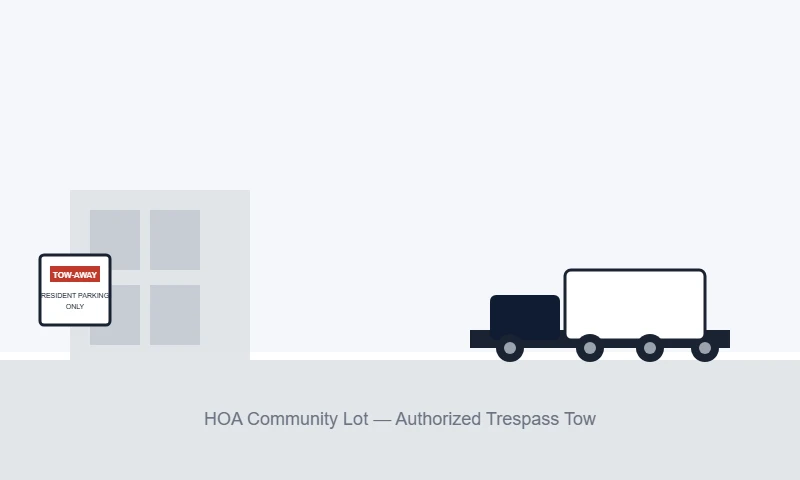
HOA Board, Reems Creek Area, Recurring Guest Overstays
A townhome association kept finding the same non-resident vehicles parked overnight in visitor spots. Once the board's governing documents were confirmed to authorize towing on their private street, we handled enforcement without the board having to call every time personally.
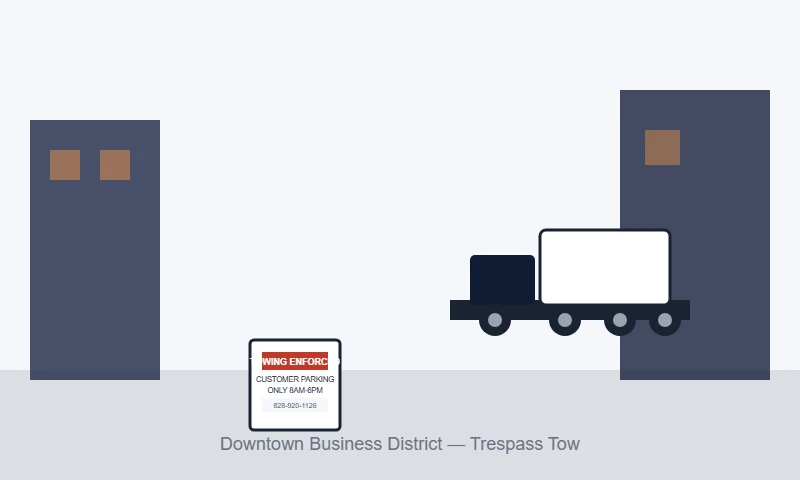
Downtown Business Lot, Customer-Only Enforcement
A retail lot in the Central Business District was getting used as free all-day parking by nearby office workers. Correct Sec. 11-18 signage went up first, and enforcement towing only started after the required 72-hour posting window passed.
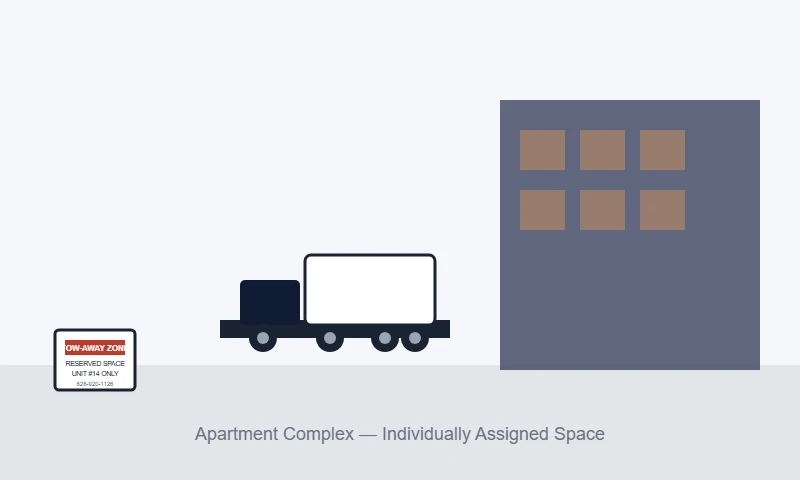
Apartment Complex, Assigned Space Repeatedly Blocked
A resident's numbered space kept getting taken by a visitor to a different unit. With the space individually marked per the ordinance, the tow was straightforward — the harder part was confirming the sign already met the per-space wording requirement before we acted.
What Property Managers Say
"They actually knew our HOA was outside the districts covered by the city ordinance. Saved us from putting up signage that wouldn't have mattered anyway."
"Our old signs didn't even have a real recovery number on them. These guys pointed that out before it became a problem instead of after."
"Straightforward about what we could and couldn't enforce. No pressure to tow more than the situation actually called for."
What Property Owners Ask Before Setting Up Enforcement
Most of what causes real trouble later comes from skipping one of these details at the start.
Can we boot a vehicle instead of towing it?
Yes, and the ordinance treats booting almost identically to towing — the same advance-notice signage rules apply, and a booting service still has to accept major credit or debit cards, keep someone on call 24/7, and release the vehicle within 45 minutes of a request.
Do we have to accept credit cards for the release fee?
Within the covered districts, yes — the ordinance specifically requires accepting at least two nationally recognized credit or debit cards. A cash-only release policy is itself a violation, separate from any issue with the tow itself.
What happens if we tow a vehicle that wasn't actually trespassing?
That's treated seriously — the ordinance sets the civil penalty at three times the standard amount when a vehicle that wasn't actually a trespass vehicle gets towed or booted. It's part of why we confirm authorization and signage compliance before a truck ever gets dispatched, not after.
Can a tenant get their belongings out of a car that's already been towed?
Yes. The ordinance requires that a vehicle operator be allowed to retrieve personal property from a towed vehicle, and separately, if the truck is still on-site and hasn't left with the vehicle yet, the owner can get the car released outright by paying the fee.
Sec. 11-18 Districts vs. Everywhere Else in Buncombe County
What Does Enforcement Towing Cost a Property?
Setting up authorized enforcement typically costs the property owner nothing upfront — the tow fee is charged to the vehicle owner at release, following the base rate structure on our towing cost page. What we do charge for, if needed, is compliant signage — we can point you to correctly worded signs meeting Sec. 11-18's exact wording and size requirements so the enforcement itself holds up if it's ever challenged.
Enforcement Towing Across Buncombe County
Downtown Asheville lots, HOA communities in Arden or Weaverville, apartment complexes near Black Mountain — same process, different governing rules depending on location. See our full service area coverage for details by town.
Other Situations We Cover
Fleet & Commercial Accounts
Property managers and HOA boards can set up a standing account with consolidated monthly billing.
View Fleet & Commercial →Emergency Towing
For accidents or breakdowns on private property that aren't enforcement-related.
View Emergency Towing →Flatbed Towing
Damage-free removal, important when a wrongful-tow dispute is a real possibility.
Private Property & HOA Towing — Frequently Asked Questions
Do I need a written contract with a towing company, or is a phone call enough?
A written agreement is worth having even where it's not strictly required — it spells out response times, storage location, and fees so there's no disagreement later. We provide one for any property setting up ongoing enforcement.
Can I make my own sign, or does it need to be professionally made?
There's no requirement that a sign be professionally manufactured, but it has to meet the exact size and wording rules if your property falls inside the covered districts. A hand-lettered sign that's missing the phone number or cost information won't hold up if a tow gets challenged.
My property doesn't have any signs up yet — can I still authorize a tow right now?
If your property is inside one of the ordinance's covered districts, no — signs have to be posted at least 72 hours before enforcement begins. Outside those districts, the requirement depends on your governing documents rather than the city ordinance, but posting clear notice first is still the safer path either way.
Can two businesses sharing one parking lot each enforce their own rules?
Yes, but the signage needs to reflect that clearly — if spaces are allocated to specific tenants or businesses, the ordinance requires each space or section to be marked with the relevant owner or lessee's name, not just one generic sign for the whole lot.
What if someone says they never saw the sign?
That's exactly why sign placement and wording matter as much as the tow itself — a sign that meets the size, height, and entrance-placement rules is much harder to argue wasn't visible. Photographic documentation of your signage helps if a tow is ever disputed.
Are the rules different for overnight parking versus daytime violations?
The sign itself has to specify the enforcement hours — whether parking is restricted 24/7 or only during specific days and hours. If your sign says "customer parking 8am-6pm" but a tow happens at 9pm, that tow falls outside what the sign actually authorizes.
Ready to Set Up Compliant Enforcement Towing?
We'll confirm which rules apply to your property before anything gets towed. Call 828-920-1126.
Call 828-920-1126