Heavy Duty Towing Isn't Just a Bigger Version of a Normal Tow
The difference between a standard tow and a heavy-duty recovery isn't just about size. It's about load distribution, rigging, approach angles on mountain terrain, and the specific risks that come with moving something that weighs anywhere from 15,000 to 80,000 pounds — or more — on roads that weren't designed with that contingency in mind. The I-40 descent through the Old Fort grade east of Asheville is demanding enough in a passenger vehicle. A disabled semi-truck on that same stretch represents a serious hazard for every driver behind it, and recovering it requires a planned approach, the right anchoring, and equipment that can actually handle the pull without compromising the rig any further.
Asheville's position at the convergence of I-40 and I-26 makes it a natural stopping point — and a common breakdown point — for commercial traffic moving between the Southeast and the Midwest. The US-74 corridor through Buncombe and Henderson counties adds another route where heavy freight moves through mountain terrain. Add to that the construction activity around the Biltmore area, the US-19/23 corridor through Weaverville, and the distribution facilities near Swannanoa and along the I-26 business corridor, and you get a picture of why heavy-duty towing demand in this county is consistent enough to warrant having the right equipment standing by rather than waiting for a call to route through a regional dispatch center three counties away.
What makes a mountain recovery harder than a flat-road recovery?
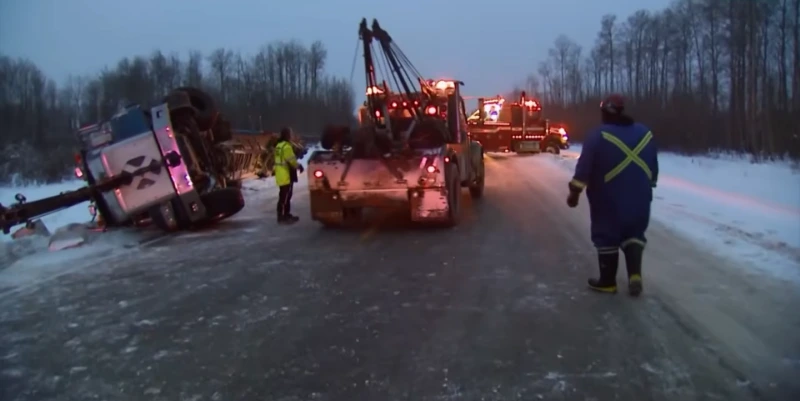
Grade, curve radius, and shoulder availability are the three things that change every calculation. On I-40's Old Fort descent, a stalled commercial truck on a six-percent grade with a narrow shoulder is a different problem than the same truck on a flat highway in the Piedmont. The recovery equipment has to be positioned uphill of the disabled vehicle in a way that controls the load through the pull rather than letting gravity work against the rigging. Curves reduce sight distance for approaching traffic, which increases the urgency of clearing the vehicle quickly while simultaneously requiring more precision to avoid secondary damage during extraction. None of this is insurmountable — it's just a reason why local experience on these specific roads matters more for heavy-duty work than it might for standard towing.
What about RVs and large motorhomes on mountain roads?
Motorhomes are their own category. They're technically passenger vehicles in terms of registration, but a Class A or Class C motorhome can weigh 20,000 to 35,000 pounds fully loaded, have suspension designed for highway travel rather than mountain grades, and have drivetrain configurations that require careful thought about which axle to lift and how to avoid damage to slides, awnings, or underbody storage compartments during loading. The Biltmore Estate area and the Weaverville corridor see steady RV traffic, particularly during the fall leaf season when Asheville draws significant tourist volume. A motorhome that can't be driven and needs recovery on a curve above the French Broad River gorge is not a quick job, and the recovery method has to account for the terrain as much as the vehicle.
Real Heavy-Duty Situations in the Asheville Area — Answered Honestly
My semi broke down on the I-40 Old Fort grade — is that area accessible for heavy recovery equipment?
It is, but it's one of the more demanding recovery locations in western NC. The six-mile, six-percent descent from Black Mountain toward Old Fort has runaway truck ramps, narrow shoulder sections, and limited sight distance around curves that all factor into how a recovery is staged. When you call, give us the exact milepost number (or the nearest ramp or landmark), the direction of travel, and whether the truck is in a pull-off, partially in a lane, or somewhere else. That information determines the approach before the wrecker is even dispatched. Do not attempt to restart and continue downhill on a truck that's showing any brake fade symptoms — pull into the nearest ramp or wide shoulder and call from there.
Can a heavy-duty tow truck reach construction sites and work yards in Buncombe County, not just highway locations?
Yes, and this matters for people operating out of the industrial areas near Swannanoa, the construction activity along the US-70 corridor east of Asheville, equipment yards in Weaverville, and the various commercial sites that have expanded along the I-26 business route. Recovery from a construction site is different from a highway breakdown because of access — soft ground, tight gate clearances, equipment that's in a non-standard position, or a machine that's stuck in material rather than just stopped on a hard surface. When you call, describe the access situation as specifically as you can. If a standard approach won't work, we tell you before dispatching rather than arriving and figuring it out on site.
I'm driving a large motorhome through Asheville and I've broken down near the Biltmore area — what do I do?
The Biltmore Estate vicinity and the US-25 corridor through south Asheville see heavy RV and motorhome traffic, particularly in fall. If you're disabled near the Biltmore interchange on I-26, near the US-25 South intersection, or somewhere in the Airport Road area, you're in a zone we service regularly. Call with the motorhome's make and length — a 28-foot Class C is a different conversation than a 40-foot Class A diesel pusher — and let us know if any slides are extended, if the vehicle has a toad (towed vehicle) attached, or if there's any visible undercarriage damage from a hard landing on a dip or speed bump. All of that affects the recovery plan.
My delivery truck is blocking a loading dock in downtown Asheville — how fast can you get there?
Downtown Asheville, particularly the Battery Park Avenue area, the River Arts District access roads, and the loading zones behind businesses on Lexington and Merrimon, can be genuinely tight for a heavy wrecker. We're aware of these access constraints and will ask about the approach before dispatch. If the vehicle is a standard box truck or step van in the 14,000 to 26,000 pound range, a medium-duty unit may be the right call rather than a full heavy wrecker — which also means a faster response and simpler access. Give us the street, the vehicle size, and whether there's clearance for a large recovery vehicle and we'll tell you exactly what's coming.
Can you recover a dump truck or concrete mixer that's gone off the road on a county road in Buncombe County?
This is a meaningful question in a county with the road profile Buncombe has — a lot of two-lane routes with soft shoulders, creek banks, and drop-offs that leave almost no room for error when a heavy vehicle wanders even slightly. A dump truck or mixer that's gone off a county road, especially one that's partially on an embankment or in a ditch, is a legitimate heavy-duty recovery requiring winching, rigging, and sometimes a rotator crane depending on the angle. The weight of the vehicle, the terrain conditions, and whether the truck is on a slope all affect the approach. Call with as many specifics as you can — the road name or nearest intersection, the direction the vehicle is facing, how far off the road it is, and approximately how much it weighs loaded or empty.
Heavy Vehicles & Equipment We Recover and Transport
Semi-Trucks & Tractor-Trailers
Class 8 over-the-road trucks, day cabs, sleepers — whether the breakdown is mechanical, a blown tire causing a dangerous lean, a jackknife situation, or an accident recovery on I-40 or I-26. These are our most common heavy-duty calls. Weight, trailer type, and cargo condition all factor into how we approach the recovery before equipment is dispatched.
Motorhomes & Large RVs
Class A and Class C motorhomes, fifth-wheel rigs with heavy towing vehicles, and diesel pushers that require recovery without damaging slides, awnings, or underbody components. Common near the Biltmore corridor and on I-26 through south Asheville.
Mountain RV recovery considerations ↓Buses & Shuttle Vehicles
Transit buses, charter coaches, shuttle vans, and school buses. These often require recovery in locations that affect passenger traffic and public safety.
Box Trucks & Fleet Vehicles
Delivery trucks, utility vans, step vans, and commercial fleet vehicles in the 14,000 to 33,000 lb range — common throughout the US-70 and I-26 business corridors.
Dump Trucks, Mixers & Construction Equipment
Dump trucks, concrete mixers, water tankers, flatbed trucks carrying heavy materials, and construction equipment such as skid steers, small excavators, and forklifts. Capacity and transport method discussed during the dispatch call based on weight and dimensions.
Matching the Truck to the Job
Where Heavy Vehicles Break Down in the Asheville Area
The geography that makes western NC a destination also makes it demanding on commercial vehicles. These are the corridors where our heavy-duty line gets the most calls.
I-40 Old Fort Grade (east of Black Mountain)
The most technically demanding stretch for commercial drivers in western NC. Eastbound trucks face a sustained descent with limited shoulder width in key sections and runaway ramp placements that tell you exactly how seriously the grade is taken. Brake failures, overheating, and mechanical issues that surface under sustained load are the most common heavy-duty calls here. Westbound trucks face a long climb that strains cooling systems and transmissions in ways that don't always show up until they're committed to the grade.
I-26 Corridor — Airport Road to Biltmore
Heavy freight, construction deliveries to the growing development corridor in south Asheville, and RV traffic converging on the Biltmore area make this stretch consistently active. The interchange at I-40 is a known congestion and incident point, and a disabled commercial vehicle in or near the interchange during peak hours has a fast-developing impact on traffic in multiple directions. Recovery here requires fast staging and clean clearance.
US-70 / Swannanoa Valley Corridor
The US-70 corridor east of Asheville through Swannanoa carries significant commercial traffic to and from distribution facilities, manufacturing sites, and the industrial areas on the eastern edge of Buncombe County. Two-lane sections with limited pullout space and heavy truck traffic heading to I-40 make breakdowns here logistically complicated — there's often nowhere to go except the narrow paved shoulder, and waiting for the wrong equipment to arrive wastes time for everyone.
US-74 / US-19-23 — Weaverville to Henderson County
Weaverville sits at the northern end of Buncombe County where US-19/23 connects to I-26, and the US-74 corridor south toward Henderson County carries a mix of commercial freight and oversized loads through terrain that gets progressively narrower. A disabled heavy vehicle on a two-lane section of US-74 near the Rutherford County line or on the Weaverville commercial strip creates a different set of access challenges than a highway breakdown — and usually benefits from local knowledge of which approach actually works for a large wrecker.
Three Heavy-Duty Jobs We've Run Near Asheville
Disabled Semi, Old Fort Grade, Eastbound Shoulder
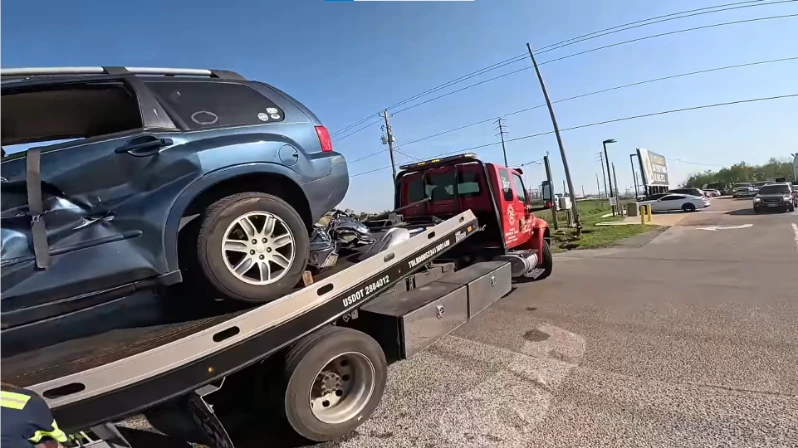
A fully loaded eastbound flatbed trailer lost air pressure and the driver managed to get the rig onto the narrow shoulder just past the second runaway ramp before the brakes locked up completely. Because the trailer was still on the grade with its rear hanging slightly into the travel lane, NC DOT had traffic control staged before we arrived. The recovery required winching the rig forward into a legal pull-off position before we could properly hook up and tow — working uphill on a loaded trailer with limited footing on the shoulder bank. The job took about two hours from first call to clear. The load was undamaged, the trailer needed brake work but no structural repair.
Class A Motorhome Breakdown, US-25 South, Near Biltmore Village
A 40-foot diesel pusher pulling a towed vehicle lost drive power on US-25 south of the Biltmore Estate entrance during fall foliage season — the busiest tourist traffic week of the year in Asheville. The slide rooms were extended on the passenger side, which meant the overall width of the unit was too wide to safely move without retracting them first. The owners had the manual override procedure in the documentation but didn't know where it was — the driver walked them through it on site before rigging. The toad was unhitched and moved separately. The motorhome was towed to a diesel service facility near the Airport Road corridor. Total time on scene about 90 minutes.
Dump Truck Off-Road Recovery, County Road Near Weaverville
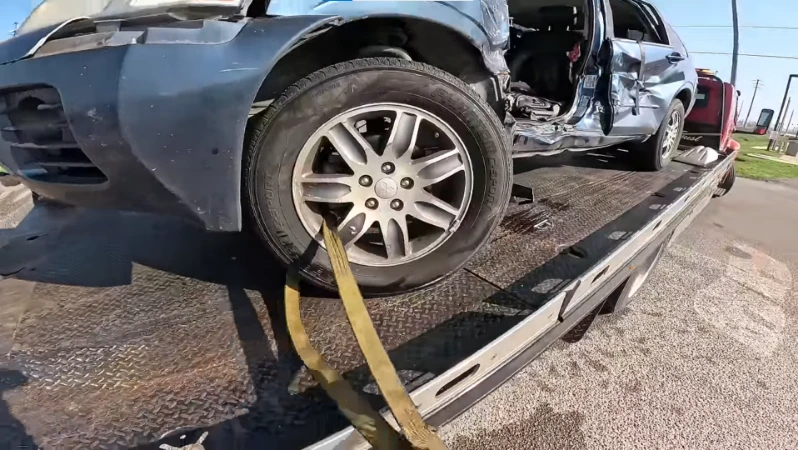
A loaded dump truck delivering fill material to a grading site off a county road north of Weaverville eased too close to a soft shoulder on a curve and the right rear wheels dropped off the edge, pulling the truck into a ditch at about a 30-degree tilt. No injuries, but the truck wasn't going anywhere without heavy recovery equipment — the load weight and the soft ground meant a winch pull alone would have buried the rear axle further. The approach required laying timber mats to distribute the recovery vehicle's weight, rigging from a fixed anchor point on the truck's frame, and using a controlled lift-and-drag to bring the truck back onto the road surface without rolling it further. The dump body was raised to redistribute load before the pull. Time on site: about two and a half hours.
What Drivers and Fleet Managers Say
"We had a tractor-trailer lose brakes on the Old Fort grade eastbound — driver made the ramp, which was the right call. Getting a wrecker to that location at 2 a.m. with a loaded trailer is not a simple job. They were honest about the timeline, gave us a number before they moved, and the driver clearly knew what he was doing on that grade. We run routes through Asheville weekly now and this is the number saved in dispatch."
"Our Class A broke down just south of the Biltmore entrance during leaf season — the absolute worst timing for traffic. I expected to be told it would be hours. The dispatcher took our info, gave us an honest arrival window, and the recovery went smoothly even with the slides extended on one side. The driver figured out the slide override without making us feel stupid for not knowing it ourselves."
"I run a small grading company and I've had two pieces of equipment go sideways on county roads in Buncombe over the past few years — a skid steer and a small excavator. Both times the recovery required proper rigging, not just a hook-and-pull. Both times the job was done without additional damage. I don't call anyone else for heavy recovery in this county."
Mountain Heavy-Duty Recovery Is Not the Same as Flat-Ground Work
The recovery equipment capacity that matters in the NC mountains isn't just about how much a wrecker can lift — it's about whether the rigging approach accounts for gravity's role in an active recovery on a grade. A loaded semi on a flat highway can be winched onto a dolly with minimal complication. The same truck on a descending six-percent grade with limited shoulder space and traffic approaching from above requires anchored rigging that controls the load through the full pull, not just at the point of initial tension.
Rotator cranes are used in situations where a disabled vehicle has gone beyond the road edge and needs to be lifted rather than dragged — a construction truck on a steep embankment, a motorhome that's listed onto a slope with no clear pull angle, or any situation where a straight-line winch approach would cause secondary damage or fail to properly clear the vehicle from its position. These aren't frequent jobs, but they're the ones that go badly wrong without proper equipment and planning.
We also work with NC DOT on highway incident management when commercial vehicle recoveries involve extended lane closures. If the recovery is going to take time, coordinating with DOT traffic control isn't optional — it's part of doing the job correctly in a way that keeps other drivers safe.
| Recovery Type | Equipment Used |
|---|---|
| Disabled semi on highway shoulder | Heavy wrecker, underreach or saddle mount |
| Jackknifed tractor-trailer | Rotator crane or heavy wrecker with winch |
| Large RV / motorhome | Heavy wrecker, soft rigging to avoid body damage |
| Construction equipment (skid steer, excavator) | Lowboy or heavy wrecker depending on weight |
| Vehicle off-road on embankment | Rotator crane, terrain anchoring |
| Air brake / brake failure recovery | Heavy wrecker with controlled approach |
How Heavy-Duty Towing Is Priced in Asheville
Heavy-duty towing costs more than passenger vehicle towing because the equipment costs more, the setups take longer, and the risk profile of the work is higher. None of that means the pricing should be a mystery. Our dispatcher gives you a number before anything moves — based on your vehicle's weight, the location, the recovery complexity, and the distance to the destination.
If the job ends up requiring more than initially described — because the vehicle turned out to be in a worse position, or an additional piece of equipment was needed — that conversation happens at the scene before extra work is done, not after. You don't get an invoice that's twice the quote without being told why first.
| Factor | Notes |
|---|---|
| Vehicle weight & type | Class 8 semi vs. box truck vs. RV — all different rates |
| Recovery complexity | Highway shoulder vs. ditch vs. embankment vs. off-road |
| Distance to destination | Quoted per mile beyond first five |
| After-hours dispatch | + ~$35 base |
| Specialized rigging / rotator | Quoted specifically based on the situation |
Heavy-Duty Dispatch Across Buncombe County and the Mountain Corridors
We cover all of Buncombe County and the interstate and state highway corridors connecting Asheville to the surrounding region — including the heavy freight routes east and south of the city.
Not All "Heavy Duty" Means the Same Truck
Dispatch matches the recovery unit to the actual weight class — sending a light wrecker to a semi just wastes everyone's time.
Heavy Duty Towing — Frequently Asked Questions
What qualifies as a heavy-duty tow?
Heavy-duty towing is used for vehicles that are too large or heavy for a standard tow truck, including commercial trucks, dump trucks, buses, motorhomes, construction equipment, and larger fleet vehicles. These recoveries require specialized heavy wreckers, higher-capacity equipment, and trained operators to move the vehicle safely without causing additional damage or creating hazards on the roadway.
Can you tow a fully loaded commercial truck?
In many cases, yes. Whether a loaded truck can be towed depends on its total weight, cargo type, road conditions, and the recovery equipment required. Dispatch will ask a few questions about the vehicle and its load before sending the appropriate heavy-duty truck. If unloading is necessary for safety or legal reasons, you'll be advised before the recovery begins.
How long does heavy-duty towing usually take?
Response time depends on your location, traffic, weather, and equipment availability. Heavy-duty recoveries generally take longer than standard passenger vehicle tows because larger trucks require more setup, safety precautions, and specialized equipment. Once dispatch understands your situation, you'll receive an estimated arrival time and updates if conditions change while the truck is en route.
Can you recover a truck that's stuck in mud or off the road?
Yes. Heavy-duty recovery often includes vehicles that have left the roadway, become stuck in mud, soft shoulders, ditches, or steep terrain. Specialized winches, recovery straps, and heavy recovery equipment are used to safely extract the vehicle before towing it. Every recovery is planned based on the vehicle's position, weight, and surrounding conditions to reduce the risk of further damage.
Do you tow construction and work equipment?
Many heavy-duty towing providers can transport construction equipment such as skid steers, forklifts, small excavators, generators, and similar machinery when the equipment falls within their towing capacity. Dispatch will confirm the equipment's weight, dimensions, and loading requirements before assigning the correct truck so the transport can be completed safely and efficiently.
What information should I have before requesting heavy-duty towing?
Having the vehicle's make, model, approximate weight, exact location, and the reason it needs towing helps dispatch send the right equipment the first time. If the truck is loaded, disabled after an accident, or stuck off the roadway, mention those details as well. Accurate information reduces delays and helps ensure the recovery is completed safely.
Can you tow trucks with air brake problems?
Yes, but the recovery method depends on the specific mechanical failure. Heavy-duty tow operators have equipment designed to safely move commercial vehicles with brake, suspension, or drivetrain issues when possible. Dispatch will ask about the symptoms so the correct recovery method and equipment can be selected before the truck is dispatched.
Do you tow box trucks, delivery trucks, and fleet vehicles?
Yes. Heavy-duty towing commonly includes box trucks, delivery vans, utility trucks, shuttle buses, and other commercial fleet vehicles. The correct towing method depends on the vehicle's size, weight, and condition. Providing accurate vehicle details during your call allows dispatch to send equipment capable of handling the job safely and efficiently.
Is heavy-duty towing available after business hours?
Yes. Commercial breakdowns can happen at any time, so heavy-duty towing is available 24 hours a day, including nights, weekends, and holidays. Whether a truck breaks down on a highway, at a loading dock, or on a construction site, dispatch can arrange the appropriate heavy-duty equipment whenever service is needed.
How much does heavy-duty towing cost?
Heavy-duty towing costs vary because every recovery is different. Pricing typically depends on the vehicle's weight, distance, recovery difficulty, equipment required, and whether specialized recovery work is involved. After learning the details of your situation, dispatch can provide a clear quote before service begins so you understand the expected cost before a truck is sent.
Commercial vehicle disabled somewhere in Buncombe County?
Tell us the vehicle, the weight if you know it, and where you are. A dispatcher answers 24 hours a day — we'll tell you what's coming and what it'll cost before anything moves.
Call 828-920-1126