Why Is Flatbed the Only Correct Way to Move an EV?
This isn't a manufacturer being cautious for the sake of it. A gas car's automatic transmission uses a torque converter that genuinely decouples the engine from the wheels in neutral — that's why a dead gas car can be towed on its wheels for a reasonable distance without harm. An EV's reduction gear doesn't work that way. The motor and the wheels are connected through a fixed-ratio gearbox with no clutch and no torque converter, so "neutral" on an EV is a software state that releases the parking brake, not a mechanical disconnection. Spin the wheels while that system is unpowered and the motor acts as a generator, pushing current back into an inverter and battery management system that aren't ready to receive it. That's how a car that looked fine on the hook arrives at the shop with a cooked inverter or damaged reduction gear.
What Happens If You Tow an EV the Wrong Way
We've had EVs arrive on other drivers' hooks with a wheel-lift dragging the front tires, or a chain looped around a control arm because nobody checked the manual first. Most of the time the owner doesn't find out anything's wrong until the car won't hold a charge properly or throws an inverter fault weeks later. None of this is exotic knowledge — it's published in every manufacturer's tow guide — but it only helps if the driver who shows up actually knows to look for it.
What is Tow Mode, and how do you turn it on?
Tow Mode (Ford and Rivian call it Transport Mode on some models) releases the electronic parking brake and disables regenerative braking so the wheels can roll freely while the car is winched onto the flatbed — it is not permission to drive the car any distance on its wheels. On a Tesla it's under Settings → Service → Towing → Tow Mode. Rivian's R1T and R1S have it under the vehicle's Service menu, and if the park brake won't release electronically, Rivian's own tow guide has drivers lift the rear wheels to load it instead. Ford's Mustang Mach-E and F-150 Lightning use a similar Tow/Transport Mode accessed through the touchscreen. All of these require the key present and enough 12-volt power to run the request — which is the next problem.
What if the 12-volt battery is dead and Tow Mode won't engage?
This is more common than most owners expect. Every EV still carries a small 12-volt battery that runs the door handles, the infotainment screen, and the control modules that decide whether to release the parking brake — and it can die on its own, completely separate from the main high-voltage pack having plenty of charge. If Tow Mode won't activate, we jump the 12-volt system first. Once it has power again, the car will usually let go of the electronic parking brake normally and load the way it's supposed to.
Where do you actually attach the winch cable?
It depends on the model, and guessing wrong is exactly how a bumper gets torn or a suspension arm gets bent. A Hyundai Ioniq has a real, rated tow hook hidden behind a small cover on the front and rear bumpers — the hook itself lives in the trunk with the tire mobility kit. Rivian's own tow operator guide is explicit that j-hooks should never go on suspension components, and specifies a front tow eye or lifting the rear wheels if the park brake won't release. Some EVs have no usable rear attachment point at all. When the manual doesn't call one out, the correct fallback is the main subframe — never a control arm, never the battery skid plate underneath.
Does a heavier EV need a bigger truck?
Often, yes. A Tesla Model Y runs close to 4,400 lbs, which most flatbeds handle without a second thought. A Rivian R1T or R1S is closer to 7,100 lbs, and a Chevrolet Silverado EV or GMC Sierra EV in top trim can push past that. We ask for the make and model on the call specifically so dispatch can confirm the flatbed being sent is rated for the actual weight, not just sized for a typical sedan.
Can you jump-start an EV like a normal car?
You can jump the 12-volt system the same way you would on a gas car — that part is genuinely no different. What you can't do is jump or bypass the high-voltage battery itself, and a dead 12-volt battery on an EV is far more disabling than on a gas car, since almost every function including the door handles and the parking brake release runs through it.
Every Kind of EV We're Equipped to Transport
The flatbed requirement is the same across the board, but the truck and the attachment approach change depending on what's actually rolling up. Here's how we think about it before a driver ever leaves the lot.
Sedans & Crossovers
Tesla Model 3 and Model Y, Hyundai Ioniq 5 and 6, Chevrolet Equinox EV, Ford Mustang Mach-E. These are the most common calls — lighter vehicles, usually a rated tow point on at least one end, and a standard flatbed handles the weight without issue.
Trucks & Full-Size SUVs
Rivian R1T and R1S, Ford F-150 Lightning, Chevrolet Silverado EV, GMC Sierra EV. These run heavier — often 7,000 lbs or more — so dispatch confirms the flatbed being sent is actually rated for the weight, not just sized for a sedan.
Hybrids & Plug-In Hybrids
Toyota Prius Prime, Jeep Grand Cherokee 4xe, Ford Escape PHEV. These still have a gas engine and a real transmission, but most manufacturers explicitly exclude them from flat-towing too — the electric motor and battery pack create the same wheel-spin risk as a full EV.
Loading an EV Without Touching the Drivetrain
Real EV Recoveries in Asheville
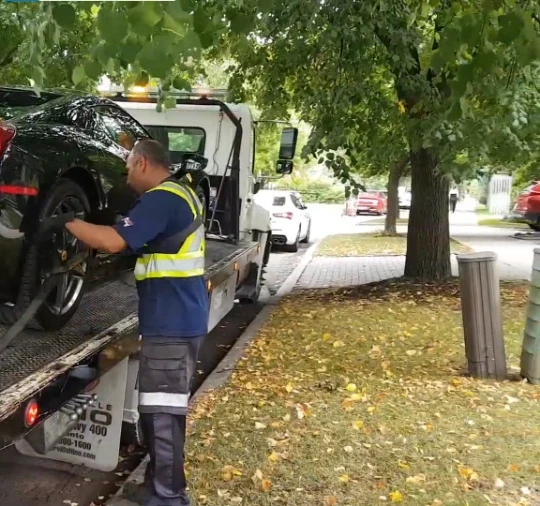
Ioniq 5, Hidden Tow Hook, West Asheville
Owner assumed there was nothing to hook to after a quick look under the bumper. The rated tow point was exactly where Hyundai's manual says it is — behind a small pop-out cover, with the hook itself stored in the trunk next to the tire mobility kit. Five minutes to find it, no guessing, no damage.
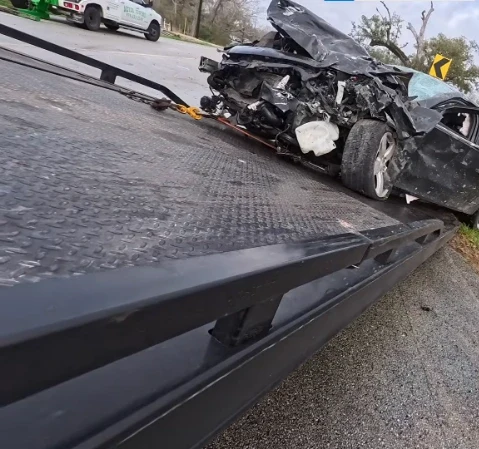
Silverado EV, Weight Check, Weaverville
A standard flatbed would have been under-rated for this one. Dispatch asked for the trim level on the call, confirmed the truck was closer to 9,000 lbs loaded, and sent a heavier-rated flatbed instead of finding out the hard way at the ramp.
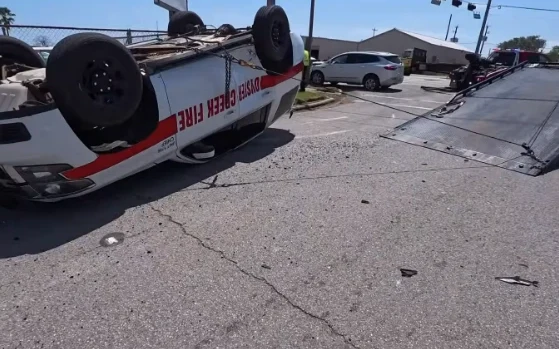
Flooded Model 3, Craggy Overlook Area
Water had been up past the door sills after a fast summer storm. Following NHTSA's guidance for submerged EVs, our driver didn't touch the vehicle until it was confirmed off any charging connection, then loaded it without contact near the underside and flagged it for a dealer inspection before anyone considered it safe to drive again.
What EV Owners Say
"Called two other companies first and both said they'd just tow it normally. These guys asked what model before anything else and knew exactly where the tow points were."
"My Ioniq's 12V died in a grocery store lot and Tow Mode wouldn't engage. Driver had it jumped and loaded in under fifteen minutes, no guesswork."
"Genuinely relieved they showed up with a flatbed without me having to insist on it. Too many stories online about wheel-lift damage to EVs."
What EV Owners Ask Before They Call
Most of these questions come up after an accident, not before one — which is exactly when it's hardest to think clearly. Here's the honest answer to the ones we hear most.
Is my EV a fire risk if it's been in an accident?
NHTSA's own guidance to towing and recovery operators says to assume a damaged high-voltage battery is still energized, even if the car looks off and quiet. Lithium-ion battery fires can also be delayed — a pack can reignite hours or even days after an incident. That's why a damaged EV gets stored with real clearance from structures and other vehicles, not parked in a tight row like a normal car, and why we watch for leaking fluid, popping or hissing sounds, or heat before calling it settled.
What if my EV has been sitting in floodwater?
Don't get back in it, and don't let anyone touch it while it's still in standing water — exposed high-voltage cabling can be present even where you can't see it underwater. Once the vehicle is clear of water, we don't assume it's fine just because it starts or looks normal; a submerged EV goes to a dealer or qualified shop for inspection before anyone calls it safe to drive.
Does towing my EV incorrectly void the warranty?
Yes, on most models. Every manufacturer we've mentioned here — Tesla, Ford, Rivian, Hyundai, GM — specifies flatbed transport as the approved method, and towing outside that spec is exactly the kind of thing that gets a warranty claim denied if the motor or battery system shows damage afterward.
Does AAA or my insurance cover EV-specific towing?
Most roadside plans cover the tow itself the same way they would for any vehicle, but not every contracted provider owns a flatbed suited to a heavier EV truck, which is part of why some AAA calls for EVs get bounced to a second company. Worth confirming with your specific provider, and worth asking whoever dispatches the truck whether the driver has actually loaded an EV before.
EV Towing vs. Gas Car Towing
Does an EV Cost More to Tow?
The base hook-up rate is the same ~$85 as any other vehicle. Since EVs require flatbed transport, the same flatbed upgrade fee applies that would apply to an AWD car or a low-clearance vehicle — it's not an EV-specific surcharge, it's the same rule applied consistently. A heavier truck like a Rivian or a Silverado EV may factor into mileage or equipment costs the same way any heavy-duty vehicle would. Either way, you get the total on the phone before a truck leaves the lot — see the full pricing breakdown for exact figures.
EV Towing Across All of Buncombe County
Same flatbed-only standard whether the call comes from downtown Asheville, Arden near the airport, Black Mountain, or out past Old Fort on the I-40 grade. See our full service area coverage for response details by town.
Other Situations We Cover
Flatbed Towing
The full breakdown of flatbed vs. wheel-lift, and why AWD needs it too.
View Flatbed Towing →Emergency Towing
Breakdown or accident right now — dispatch gets your location first.
View Emergency Towing →Long Distance Towing
Moving an EV to a dealership or shop outside Asheville, fixed price.
View Long Distance Towing →Accident Towing
Post-collision recovery, including EV-specific safety handling.
View Accident Towing →EV Towing — Frequently Asked Questions
Can I request a specific size truck when I call?
Yes, and for a heavier EV truck we'd rather you did. Tell dispatch the make and model on the call and we'll confirm the flatbed being sent is actually rated for the weight, rather than showing up with something sized for a sedan.
Does a regular tow truck driver know how to handle an EV, or do I need someone specific?
Not every driver at every company has loaded an EV before, which is part of why the wrong-attachment-point damage stories exist. Our drivers are briefed on tow point locations and Tow Mode activation for the common models we see in this area — Tesla, Hyundai, Ford, Rivian, and GM's electric lineup.
Do I need to be there when my EV gets loaded?
Not required, but helpful if you know where the key is and whether Tow Mode has already been activated. If the car is at your house or workplace and you can leave the key with someone on scene, that's enough.
Can you tow my EV to a specific dealership instead of the nearest shop?
Yes — tell dispatch the destination when you call and we'll quote the price for that specific drop-off point, not just the nearest option.
Is there anything I should do before the truck arrives?
If you can safely access the vehicle, having the key ready and knowing your battery's approximate charge level helps, especially for longer moves. Beyond that, just get somewhere safe and let dispatch know your exact location.
Does snow or ice change how you tow an EV?
The loading process stays the same, but a stranded EV in winter conditions on somewhere like the Old Fort grade or Blue Ridge Parkway adds drive time for us to reach it, which we'll be upfront about on the call.
I'm not sure if my car counts as a full EV or a hybrid — does it matter?
Tell us what you're driving and we'll tell you how it needs to move. Plug-in hybrids like the Jeep 4xe or Ford Escape PHEV get the same flatbed treatment as a full EV, while a standard (non-plug-in) hybrid usually tows more like a normal gas car — but we confirm rather than assume either way.
Will my EV's charge level drop a lot from being towed?
A short local tow has no meaningful effect on charge. It only becomes a consideration on transports that sit on a trailer for many hours, where an extreme charge level — very high or very low — adds thermal stress compared to a moderate one.
Need Your EV Towed in Asheville?
Flatbed only, every time — call 828-920-1126 and tell dispatch the make and model.
Call 828-920-1126